Writing for Learning

Page One

Essential writing skills for learning design.

Created for new learning designers and their managers, Page One develops one of the profession's most overlooked capabilities: 
writing. 

Because every learning experience begins as words on a page.

Page One is available as a self-directed guide and a ready-to-use facilitation pack for trainers and managers looking to upskill their teams.

Not ready to deliver training? Book a workshop.

GET THE GUIDE GET THE FACILITATION PACK BOOK A WORKSHOP

Writing is a design process.

Page One covers every stage, from knowing your audience to integrating AI.

Modular sections, built around writing challenges from real learning design projects.

Worked examples that show weak writing transformed, and teach you how to transfer to your own work.

Practice exercises and checklists you can use on your projects today. 

AI practices to review and improve generated content, not just accept it.

It's the resource experienced instructional designers wish they'd had when they started.

The guide will support you to:

Analyse a learning audience to write for a specific learner, not a generic one.

Write assessments, feedback, scenarios and scripts that support behaviour change.

Write measurable learning outcomes that guide design decisions and make it easy to craft an effective assessment.

Make decisions at the script stage that prevent expensive problems in translation, on mobile, and for learners who need accessible content.

Match your tone to the organisation and the learner, not the source document.

Use AI as an editorial tool, without losing the judgment that makes writing good.

Edit for clarity, brevity and usability.

Evaluate your own work with the checklists, pre-flight reviews, and prompts built into every section.

Who is it for?

The variety of writing backgrounds people bring into learning design is vast.

Career transitioners from education, HR, technical writing, marketing, and subject matter experts each arrive with strong writing skills - and specific blind spots.

If you came through formal ID training, you likely got a solid foundation in theory, tools, and process, but less support to develop writing as a skill in its own right.

If you're a manager, you know what good looks like. What's harder is articulating how you know what you know, and cascading those standards to a team (especially a team working with generated copy).

GET THE GUIDE GET THE FACILITATION PACK BOOK A WORKSHOP

What's inside

Fifteen sections of practice-based writing advice, organised around the tasks instructional designers perform on every project. Each section names a real writing problem, shows you what good looks like, and gives you the tools to apply it. Read it cover to cover, or skip to the section that matches what you're working on now.

01 
Know Your Audience

Build a learner persona that changes what you write.

02 
 Learning Outcomes

Turn vague intentions into measurable performance. 

03 
Tone of 
Voice

Match the culture, not the source document. 

04 
Plain 
Language

Write clearly without oversimplifying. 

05 
The Art of 
the Cut

Edit your own work, even when you've stopped seeing it clearly. 

06 
STAKEHOLDER EDITS

Classify feedback to push back with evidence, not opinion.

07 
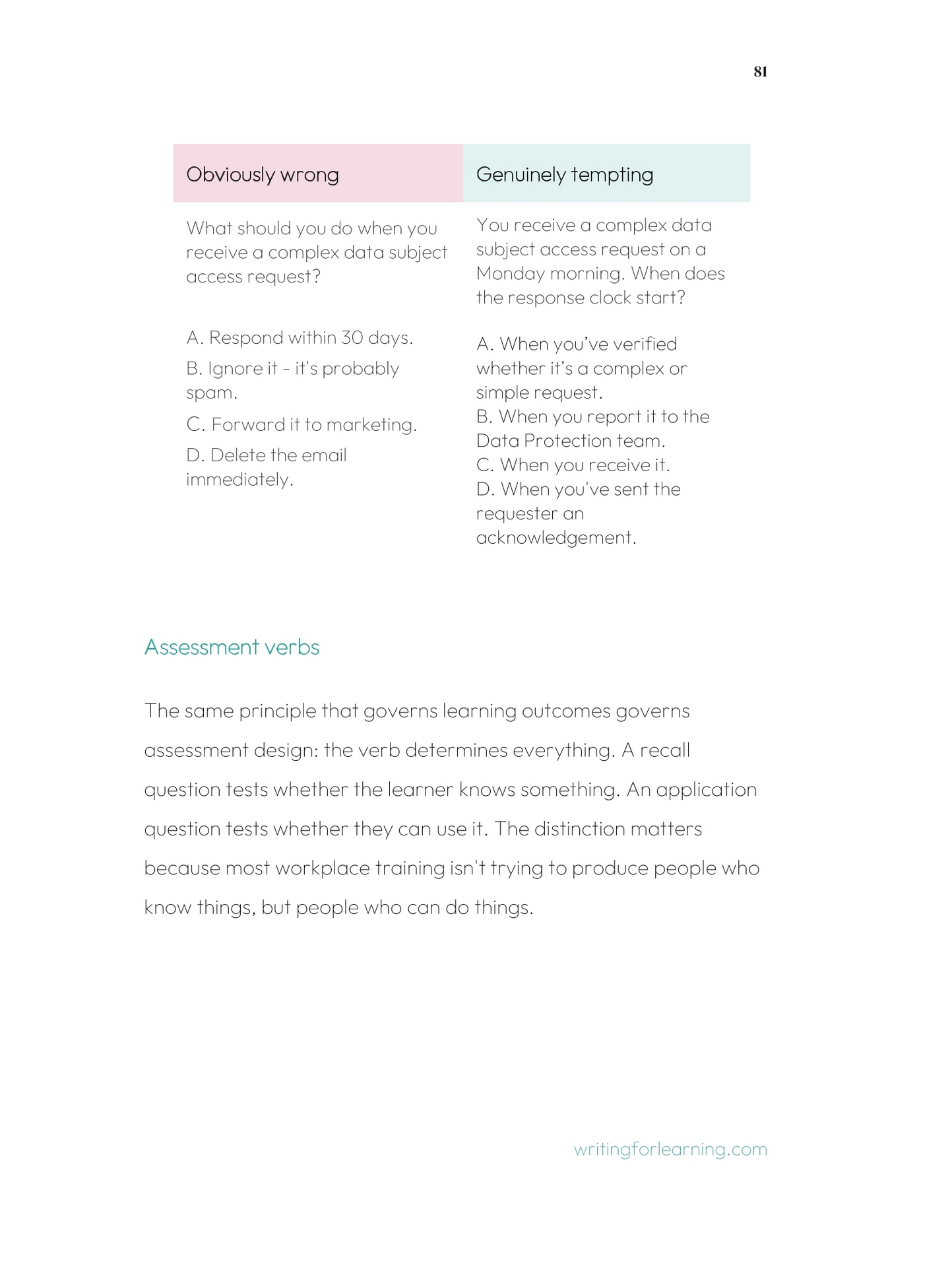
 ASSESSMENT QUESTIONS

Design questions that measure performance, not just memory.

08 
FEEDBACK THAT TEACHES

Use the highest-leverage learning moment effectively. 

09 
Character Dilemmas

Build compelling scenarios from the learner need outward.

10 
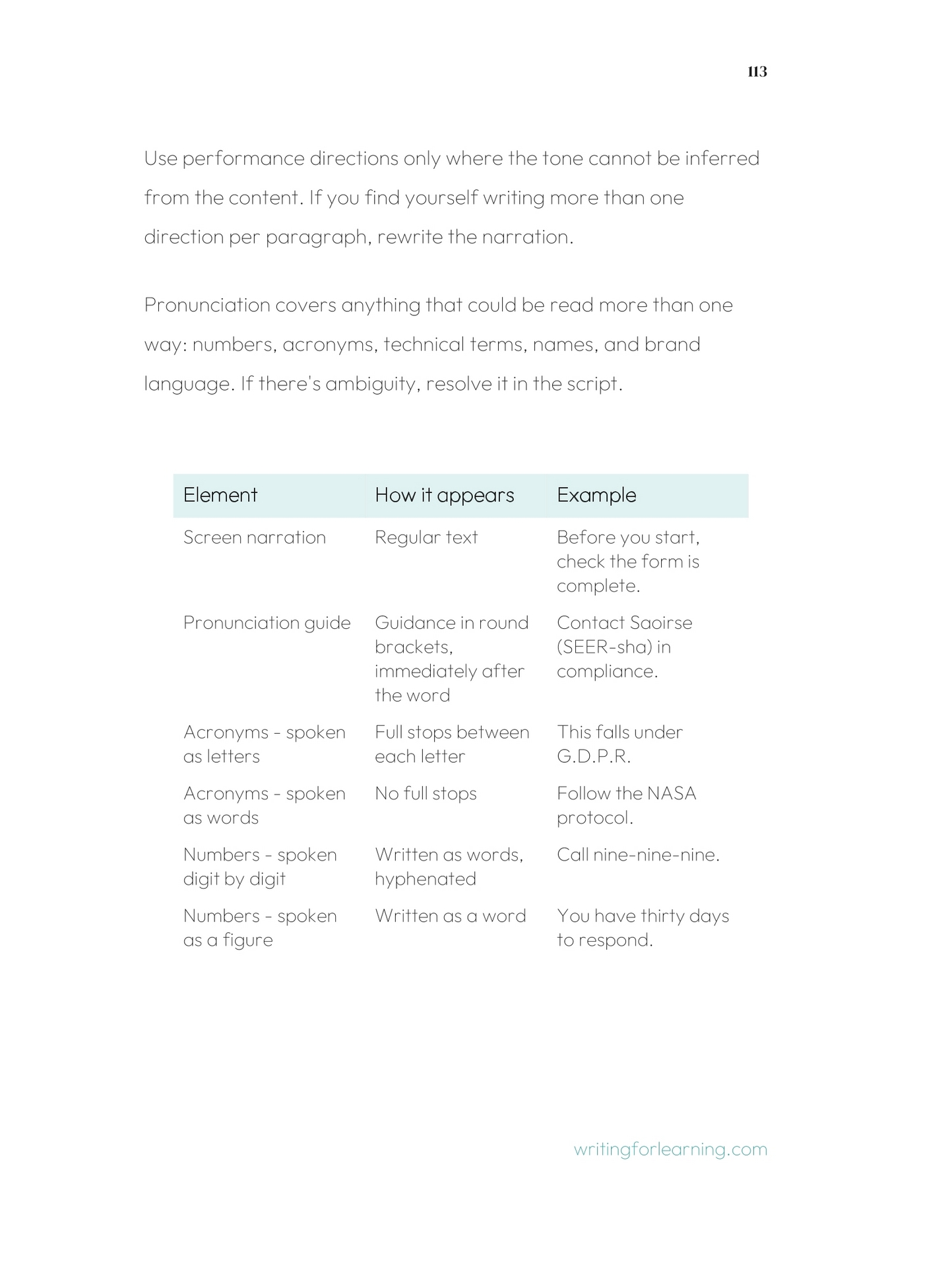
WRITING FOR VOICEOVER

Write for the ear, not the eye. 

11
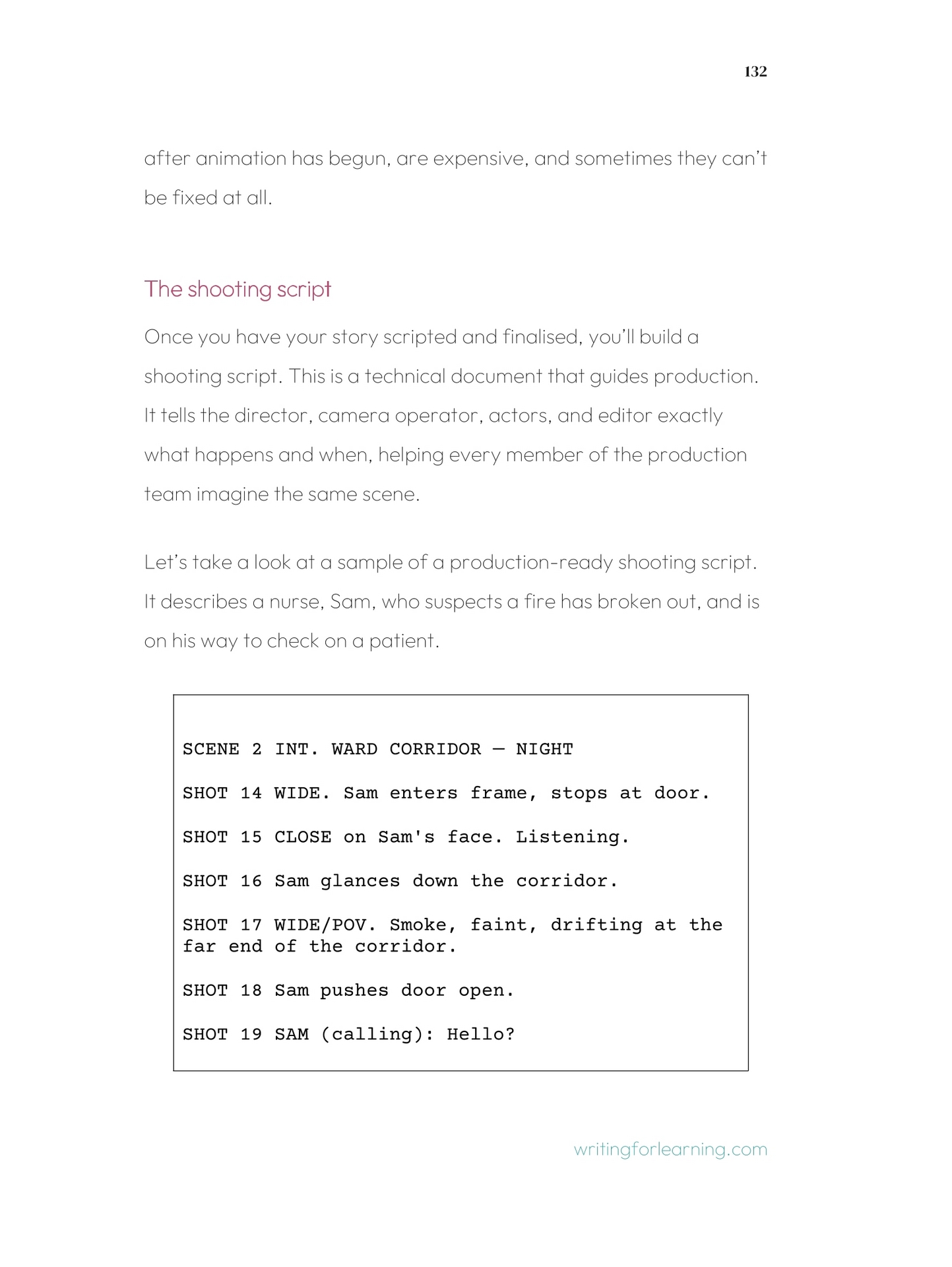
WRITING FOR VIDEO

From an objective to a production-ready script.

12 
 MOBILE-FIRST DESIGN

Write and edit for the smallest possible screen. 

13 
beyond the module

Craft resources that actually transfer to work.

14 
Translation & Accessibility

Make script stage that prevent  problems later.

15 
INTEGRATING
AI

Use AI without compromising quality.

Take a peek...

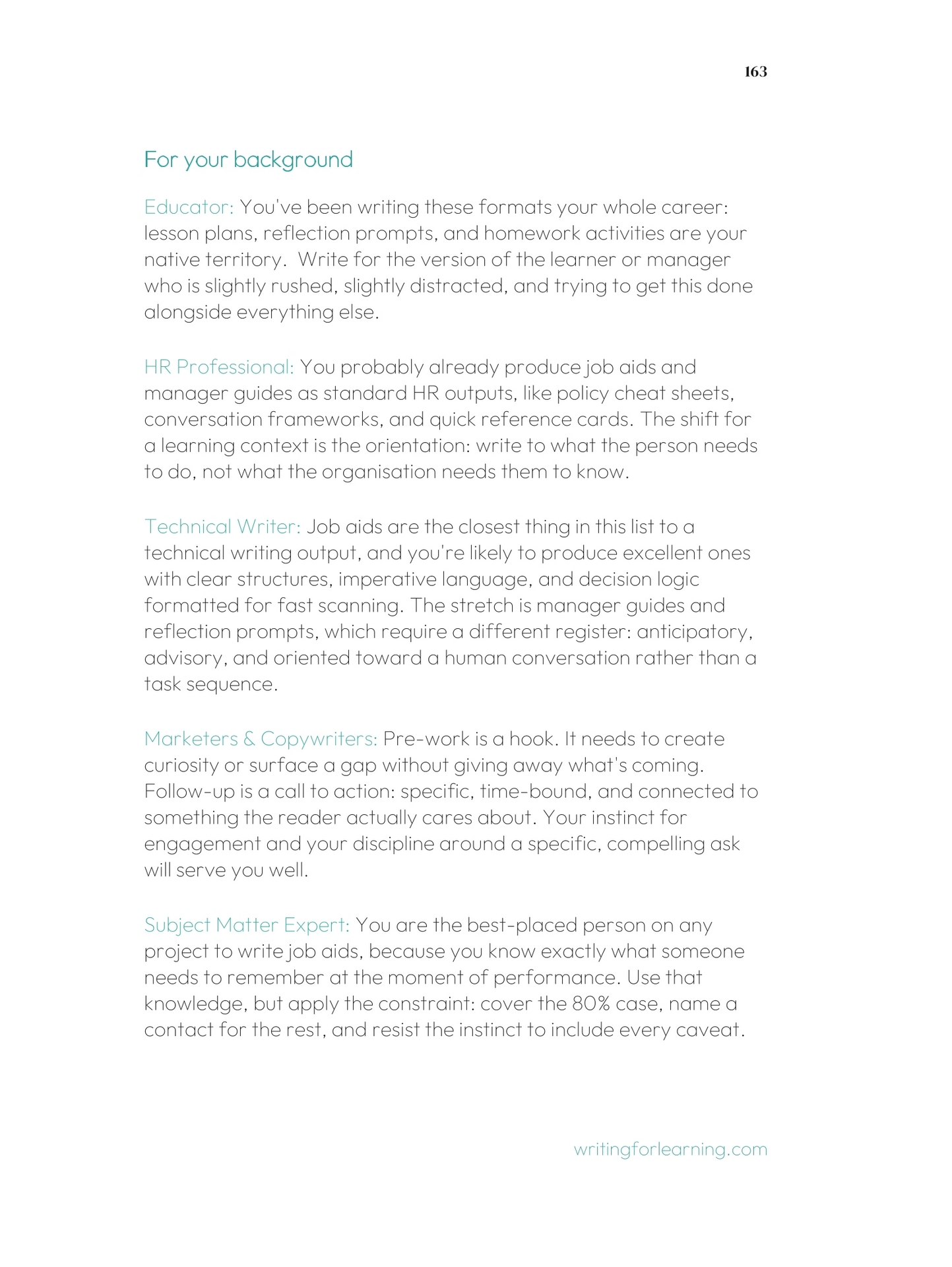
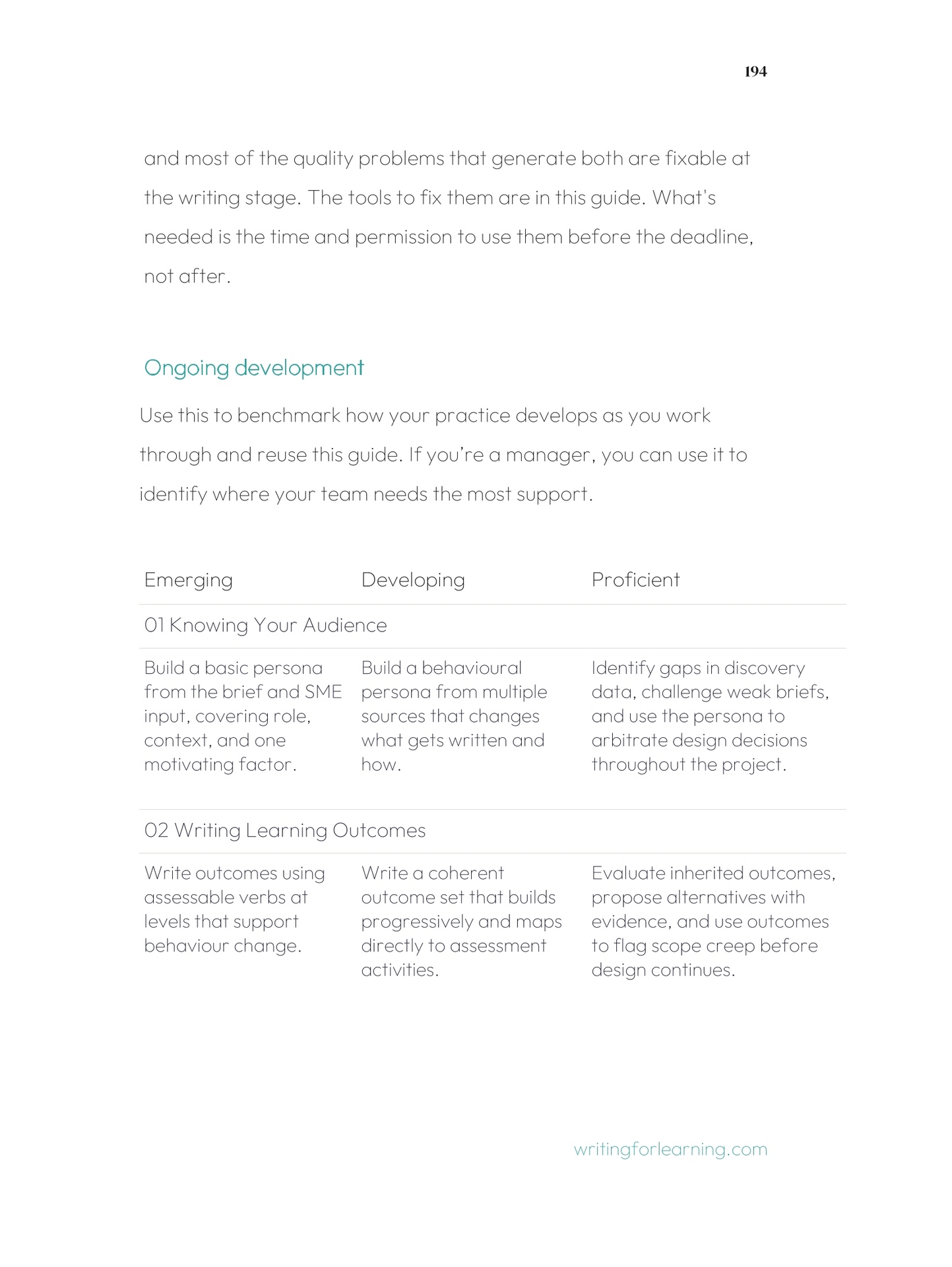
Browse sample pages

The essential guide for instructional designers,
yours to use on every project.

200+ pages of practical guidance, templates and worked examples. 

€24.99


SECURE YOUR COPY

Instant digital download.
Preferred currencies available at checkout.

Created from 15 years of learning practice.

Page One was created by Majella Munro, a learning designer, writer, and educator with experience across higher education and corporate learning. 

Majella holds a PhD, a Postgraduate Certificate in Higher Education Practice, and a CIPD award in Coaching and Learning & Development. 

She has worked for multiple sectors and industries, across four continents, supporting over a million learning sessions. She has managed design teams, supporting onboarding, capability development, and upskilling, including at companies serving the AI hyperscalers. 

Page One brings together practical learning design experience with writing and storytelling expertise to help instructional designers develop the judgement they need to create clear, effective learning experiences.

FAQ

What is the difference between the Guide and the Facilitator pack?

The Guide is a self-paced resource for instructional designers who want to build stronger foundations in learning-focused writing. It presents explanations, examples, exercises, and practical prompts you can apply to your own projects.

The Facilitation pack is for experienced instructional designers, managers, and learning leaders who want to present Page One to their team. It includes workshop materials, facilitator guidance, and activities to help organisations develop a shared standard for instructional writing.

How is Page One different from other instructional design guides?

Many instructional design resources focus on models, processes, tools, and delivery approaches. Page One focuses on writing as a foundational skill, covering how to craft objectives, explanations, scenarios, assessments, feedback, narration, and learning experiences that help people think and perform differently. 

It is a practical foundation for instructional designers who want to move beyond assembling content and develop stronger design judgement.

How is Page One different from a writing or copywriting course?

Page One is not a grammar guide or a general writing course.

Copywriting focuses on persuasion. Creative writing focuses on expression and storytelling. Page One focuses specifically on instructional writing: communicating ideas clearly, guiding attention, supporting understanding, and helping learners apply what they know.

Is Page One suitable for experienced instructional designers?

Page One is designed primarily as a foundation for new instructional designers, career changers, and anyone who wants to strengthen their learning writing skills.

Experienced instructional designers may find more value in the Facilitator pack, which helps teams apply the Page One guidance consistently across projects.

Can I use Page One with AI?

Yes. Page One is designed for a world where AI can generate content quickly, but human judgement remains essential.

The guide includes prompts and review techniques to help you question, refine, and improve AI-generated writing rather than simply accepting the first output. The method works whether you are writing from scratch or collaborating with AI.

Want to see more? 
Download a sample chapter before you buy.
SEE more